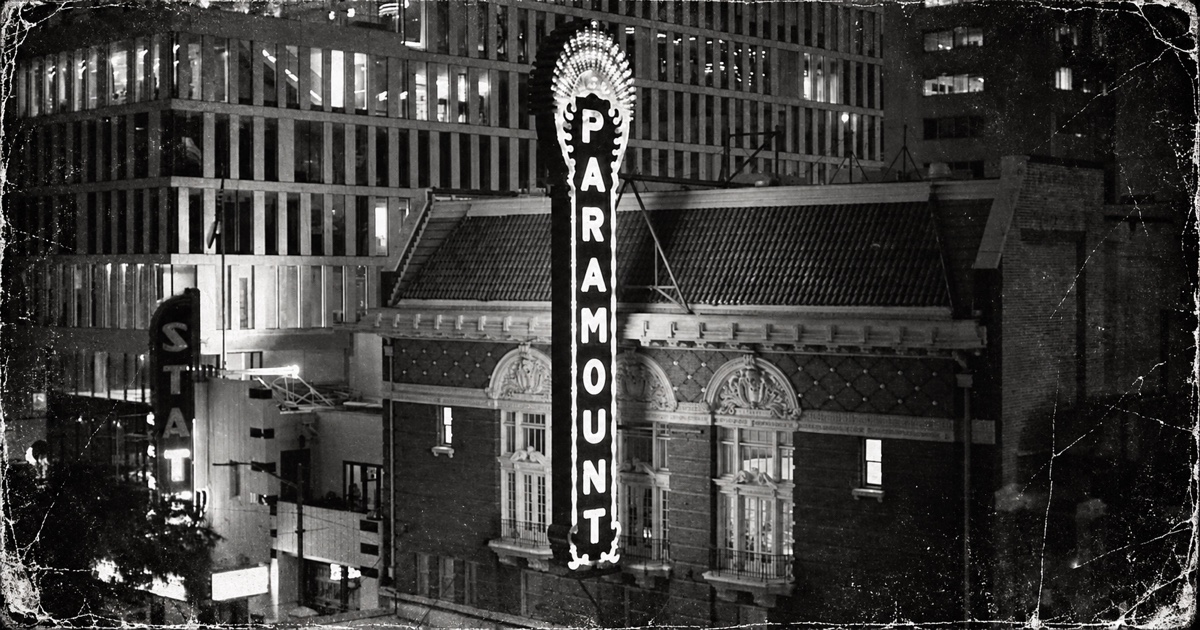
A stage where the past never really cleared
Austin’s Paramount Theatre has spent more than a century absorbing applause, footfalls, and the odd rumor that something unseen still lingers backstage. Opened in 1915 as the Majestic Theatre, the building began as a vaudeville house and later became the Paramount in 1930 after a major remodel tied to the rise of film. Today it remains one of the city’s best-known cultural landmarks, still operating as a live performance venue in downtown Austin. (austintheatre.org)
That longevity is part of what feeds the hauntings. In a place that has hosted touring acts, movie premieres, restoration efforts, and decades of staff turnover, old stories can settle into the walls almost as firmly as the architecture itself. But the difference between history and haunting matters here: the theater’s documented past is substantial, while its paranormal reputation is built mostly from reports, lore, and interpretation. (austintheatre.org)
What the Paramount’s records actually show
The Paramount’s own history places the building’s birth in 1915, with the first opening night on October 11 of that year. It also documents a 1930 renovation and rebrand, when the old Majestic became the Paramount after an extensive Art Deco remodel. The theater later survived a difficult stretch in the 1970s, when downtown decline nearly left it for dead, before preservation efforts brought live performance back to the stage. (austintheatre.org)
That documented arc explains why the theater feels layered. It is not a single-purpose ghost story location but an actively used venue with visible traces of each era: vaudeville roots, silent-film years, major restoration, and the modern performance calendar. The building itself supplies the atmosphere; the haunting claims come later. (austintheatre.org)
Houdini, legends, and the power of a good backstage tale
One of the better-known bits of Paramount lore is the so-called Houdini hole in the auditorium ceiling. The theater’s history page says legend holds that it was carved for a suspended levitation trick during Harry Houdini’s 1916 appearance. That detail is part of the venue’s folklore rather than a ghost claim, but it shows how quickly theatrical history and theatrical mystery can blend in a building like this. (austintheatre.org)
The same pattern appears in the ghost stories that have circulated around the Paramount for years. Even when a claim cannot be independently verified, the theater’s own staff and outside coverage have acknowledged that ghost stories are part of the venue’s public identity. KUT has described Austin ghost stories as including the Paramount, and a city tourism document notes that tour guests might even hear a few ghost stories while learning the building’s history. (kut.org)
Charlie in the wings, and the stories that follow him
The legacy Ghost Texas article names a former stagehand called Charlie as the Paramount’s best-known ghost. That specific story appears to live in oral tradition and repeated retellings rather than in clearly documented historical records. I could not verify, from reliable primary or institutional sources, a corresponding fatal backstage accident or a preserved record tying a stagehand named Charlie to the theater’s haunting reputation. Treat it, then, as folklore: a local backstage legend, not an established fact. (austintheatre.org)
That does not make the story uninteresting. It makes it recognizable. Haunted-theater lore often centers on workers, projectionists, stagehands, and performers because those are the people most plausibly imagined as never quite leaving. In the Paramount’s case, Charlie’s reported behavior, knocking, moving equipment, appearing near the wings, fits the classic profile of a theatrical presence that is felt more in routine disruptions than in dramatic apparitions. But again, these remain witness reports and legend, not independently confirmed events. (kut.org)
The woman in white and the balcony’s old secret
The other recurring story in the legacy piece is a ghostly woman in a white dress said to haunt the balcony. As with Charlie, I found no authoritative source that establishes her identity or verifies an actual death at the theater connected to the tale. What does survive is the shape of the story itself: a seated figure glimpsed above, a white dress in the dimness, the suggestion of an audience member who never left. That image persists because it belongs to the language of old theaters, where balconies can feel like private boxes for the unseen. (austintheatre.org)
The Paramount’s surviving features help explain why these stories remain so sticky. It still uses traditional theater seating and retains architectural elements from its early years, including a rigging system the theater highlights as unusually old-fashioned. Spaces that preserve the mechanics of another century naturally invite the feeling that something else from that century might still be nearby. That is not proof of a haunting, but it is good atmospheric evidence. (austintheatre.org)
Why the haunting reputation has lasted
What keeps the Paramount in Austin’s haunted canon is not a single dramatic incident but accumulation. The building is old enough to have memory, famous enough to attract stories, and active enough that unexplained noises or backstage oddities can be retold quickly. Over time, those moments become part of the venue’s personality, whether or not they point to anything supernatural. (austintheatre.org)
So the Paramount Theatre stands in an interesting middle ground: documented landmark on one side, enduring ghost story on the other. The history is easy to verify. The haunting is not. And maybe that tension is exactly why the stories still work, because in a theater built for performers, even the silence can feel staged. The unanswered question is not whether the Paramount has a ghost, but why certain old rooms make us so ready to hear one.