Where the walls remember more than one century
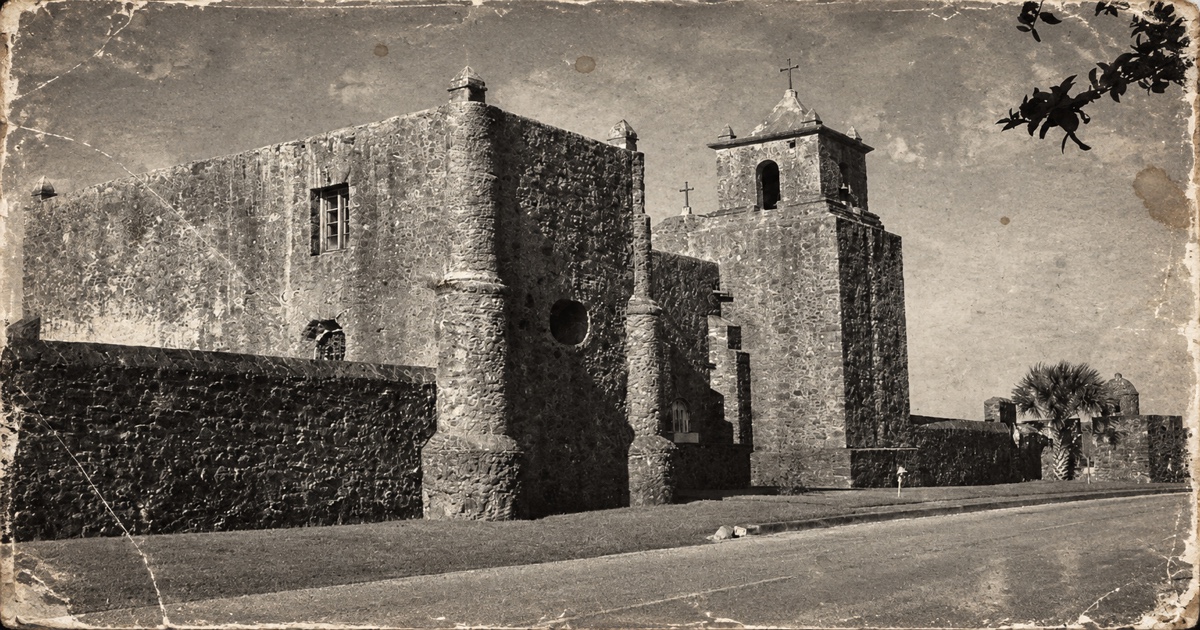
Presidio La Bahía does not need embellishment to feel heavy with history. Built in 1749 and later rebuilt on the site that now anchors Goliad, the presidio became one of the most important Spanish colonial military posts in Texas. Today it stands as a rare surviving fort of the era, a place where the layers of mission life, frontier defense, and revolution still read clearly in the stone and chapel grounds. (thc.texas.gov)
The setting alone explains part of the site’s reputation. Goliad is one of the oldest places in Texas history, and Presidio La Bahía sits at the center of that story: a military outpost, a religious compound, and later a stage for the violence of the Texas Revolution. The atmosphere visitors describe today is inseparable from what happened here before any ghost story was ever told. (tshaonline.org)
The fort that became a symbol of Goliad
The presidio was established to protect Spanish interests in the region, but its long life made it witness to much more than defense. It was tied to the 1812, 1813 Gutiérrez-Magee expedition, the 1835 and 1836 Goliad campaigns, and the political upheaval that shaped the road to Texas independence. The Texas Historical Commission and the Handbook of Texas both identify the site as central to those conflicts, not as a legend, but as a documented historic landmark. (thc.texas.gov)
That matters because the haunted reputation of Presidio La Bahía is not built on some vague old ruin. It is built on a place where soldiers slept, prisoners were held, orders were carried out, and the ground itself became part of Texas memory. The fort’s age gives the stories room to breathe; its history gives them weight. (home.nps.gov)
March 1836 left the deepest imprint
The strongest reason Presidio La Bahía continues to draw paranormal interest is the Goliad Massacre. On March 27, 1836, after the Battle of Coleto, Col. James W. Fannin and hundreds of Texian soldiers were prisoners under Mexican control. According to the Handbook of Texas, many were executed outside the presidio, while wounded men unable to march were killed within the fort under Mexican command. Roughly 350 Texans were killed overall, and the event became one of the defining tragedies of the Texas Revolution. (tshaonline.org)
The legacy article’s claim that “over 300” men were executed is broadly in line with the scale of the event, though historical accounts vary in how they count the dead and the wounded. What is not in doubt is that the massacre hardened “Remember Goliad” into a rallying cry and made the presidio a place Texans associate with sacrifice as much as survival. (tshaonline.org)
The ghost stories that keep the chapel doors open in the imagination
This is where documented history gives way to witness report and folklore. Visitors and ghost-hunting accounts commonly repeat claims of a headless figure, often identified as Col. Fannin, along with phantom gunfire, sword sounds, cold spots, flickering lights, and the sense of unseen presences near the chapel and fort grounds. These stories are part of Presidio La Bahía’s modern identity, but they remain claims and reports rather than independently verified events. (thc.texas.gov)
The headless-man story in particular fits a familiar haunted-site pattern: a violent death or mass execution gets attached to a named historical figure, then the legend accumulates detail over time. At Presidio La Bahía, that process is easy to understand. When a place is already associated with a massacre, any unexplained sound can feel like a continuation of the story rather than an accident of wind, timber, or memory. That does not prove a haunting, but it does explain why the tale survives. (tshaonline.org)
Why the stories cling to this place
Presidio La Bahía is still an active historic site with tours, living history programs, and March commemorations tied to the Goliad Massacre. Those public interpretations keep the past present in a way few Texas landmarks can match. Reenactments, chapel visits, and the preserved fort layout all invite visitors to imagine what the site felt like before restoration and tourism softened its edges. (thc.texas.gov)
That may be the real reason the haunting claims persist. Some places collect ghost stories because they are isolated or decaying. Presidio La Bahía collects them because it is intact. The walls are still there, the chapel is still there, and the most famous trauma tied to the site is not distant myth but a documented event with names, dates, and survivors. In a place like this, even silence can feel historical. (tshaonline.org)
What remains unresolved is not whether Presidio La Bahía matters, it clearly does, but whether the odd sensations visitors report are echoes of history, a product of suggestion, or something that never quite left the fort after March 27, 1836.